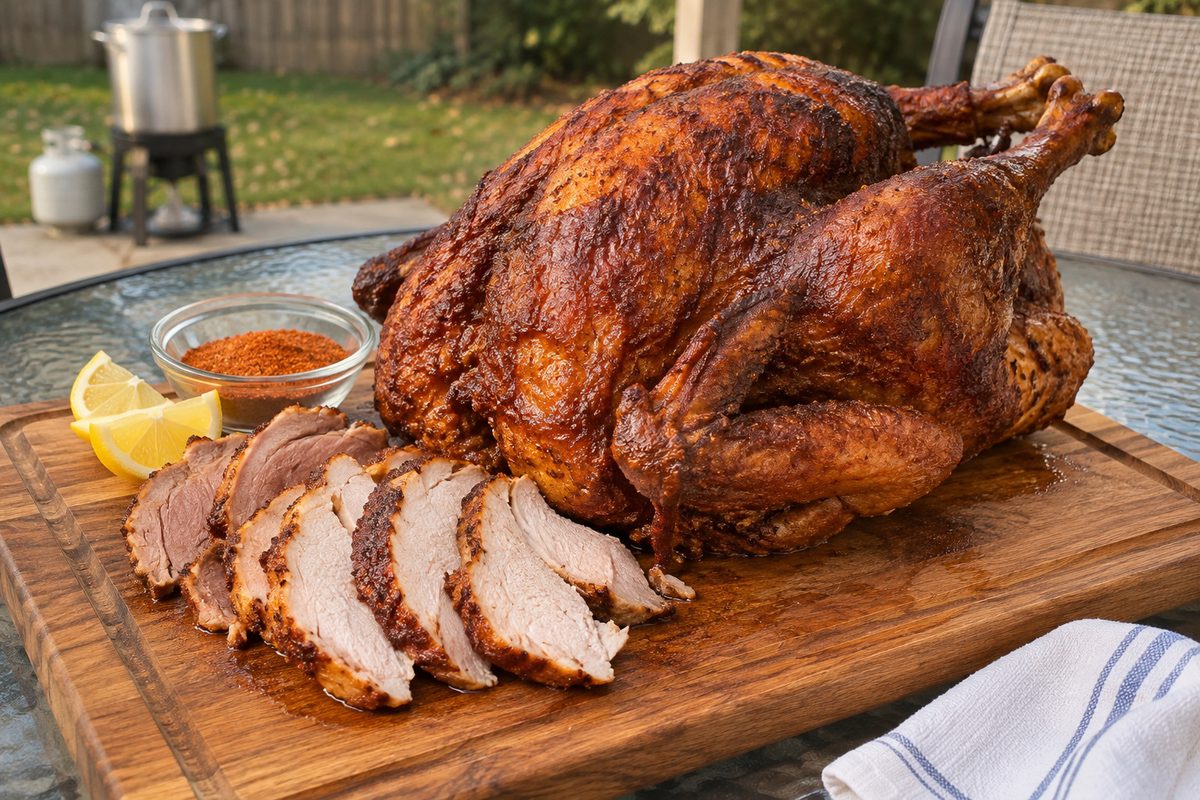
What changes
What makes this Deep-Fried Turkey lighter
A dry rub the night before
Instead of: An injected butter marinade
The rub seasons the meat and dries the skin, so it crisps and spatters less. Injected butter adds fat, and liquid in a bird going into hot oil is a burn risk.
The butter: 1 cup is about 1,630 calories
Oil held at 350°F
Instead of: Oil that drifts below 340°F
Cooler oil soaks into the skin instead of crisping it. Turn the burner back up once the turkey is in and watch the thermometer.
A greasy, oil-soaked skin
Skin removed on your plate
Instead of: Skin eaten
Most of the oil a fried turkey takes up stays in the skin.
Saves about 60 calories per 4 oz
A 10- to 12-lb turkey
Instead of: A 16- to 20-lb bird
USDA's limit for frying is 12 lb. A smaller bird fits the pot, cooks evenly and is easier to lift. For a crowd, fry two.
Less hot oil to heat and handle
Recipe
How to make Deep-Fried Turkey
Prep 30 min, plus the water test and an overnight rub · Cook 30 to 60 min, plus 20 min rest · Serves 12 · each serving (4 oz sliced turkey, white and dark, skin removed)
Ingredients
- For the turkey
- 1 whole turkey, 10–12 lb, fully thawed, neck and giblets removed (not stuffed)
- For the rub
- 2 tbsp Diamond Crystal kosher salt, or 3½ tsp Morton kosher salt (leave it out if the turkey is kosher, self-basting or 'enhanced')
- 1 tbsp smoked paprika
- 2 tsp garlic powder
- 2 tsp onion powder
- 2 tsp dried thyme
- 1 tsp black pepper
- ½ to 1 tsp cayenne pepper
- For frying
- Refined peanut oil or canola oil, the amount from the water test
- Equipment
- Outdoor propane turkey fryer with a pot big enough to pass the water test, a basket or rack, a lifting hook and a deep-fry thermometer
- Instant-read food thermometer
- Fire extinguisher for grease fires (Class K, or a multipurpose ABC at minimum)
- Heavy grill gloves, safety glasses, long sleeves and closed shoes
Method
- Thaw the turkey completely in the fridge, about 24 hours for every 4 to 5 lb. Check the cavity: no ice and no frozen spots. Remove the neck and giblets.
- The day before, do the water test before you season: set the turkey in the fryer basket in the empty pot and add water until the turkey is covered by about an inch. Lift it out, let it drain and mark the water line; that's your oil line. If the line is close to the rim, the pot is too small. Pour out the water and dry the pot completely.
- Pat the turkey very dry inside and out. Mix the rub and rub it all over the turkey and under the breast and thigh skin. Refrigerate it uncovered on a rack on the bottom shelf, at 40°F or below, overnight. The skin dries out, which means less spatter and crisper skin.
- On frying day, set up outdoors on flat, level dirt or concrete, in the open and well away from the house, garage, deck, trees and anything that can burn. Never fry in rain or snow, or in, on or under a garage, porch or carport. Keep the propane tank at least 2 feet from the burner with the wind blowing the heat away from it, and keep children and pets well back.
- Fill the dry pot with oil to the water-test line. Clip on the deep-fry thermometer and heat the oil to 350°F. Stay with it the whole time: most fryer fires start while the oil heats. If it smokes, turn off the gas.
- Pat the turkey dry once more and set it in the basket, neck end down. Turn the burner off. Wearing gloves and safety glasses, lower the turkey into the oil very slowly, over about a minute.
- Relight the burner and bring the oil back to 350°F. Keep it there. Fry about 3 to 5 minutes a pound: roughly 30 to 50 minutes for a 10-lb turkey and 36 to 60 minutes for a 12-lb one.
- At about 3 minutes a pound, turn the burner off and lift the turkey slowly out of the oil. Check it with a food thermometer: it's done at 165°F in the innermost thigh, the innermost wing and the thickest part of the breast. If not, lower it back in and check again in 5 minutes.
- Drain the turkey on a sturdy tray lined with paper towels. The skin will be golden to dark brown, sometimes almost black. Let it rest 20 minutes, then carve.
- Turn off the gas at the tank and leave the oil where it is until it's completely cool; it stays dangerously hot for hours. To reuse it, strain it, cover it, refrigerate it and use it within a month.
- If the oil ever catches fire, call 911 and never use water. Turn off the gas at the tank only if you can do it safely, and use the fire extinguisher from a distance.
- Refrigerate leftovers in shallow containers within 2 hours and eat them within 3 to 4 days.
Quick answers
Deep-Fried Turkey, weight, protein and sugar
Can I eat Deep-Fried Turkey for weight loss?
Yes, if you take the skin off: 4 oz is about 180 calories with 32 g of protein, only about 10 more than roast turkey without skin. With the skin it's about 240.
How much protein is in it?
About 32 g in 4 oz without the skin and 31 g with it.
What about sugar?
No carbs and no sugar in the turkey or the rub, so it won't raise blood sugar by itself. The carbs on the plate come from the sides.
Tips
Before you cook
- USDA's size limit for frying is 12 lb, and your fryer's manual may set its own; follow the lower one. For a crowd, fry two turkeys, or fry a bone-in breast and the legs separately.
- Check the oil temperature every few minutes. It drops when the turkey goes in and can climb fast once it recovers.
- Peanut allergy at the table? Fry in canola oil, or tell guests it was fried in peanut oil so they can decide. Cold-pressed or gourmet peanut oil carries more peanut protein than refined oil.
- Watching sodium? Use half the salt in the rub and season slices at the table.
- Throw the oil out if it turns cloudy, foams or smells off, sealed in a container for the trash. Never pour it down the sink.
Common questions
Deep-Fried Turkey: common questions
How long does it take to deep fry a 12-lb turkey?
About 36 to 60 minutes at 350°F, using USDA's 3 to 5 minutes a pound. Start checking at about 36 minutes and stop when it reads 165°F in the thigh, wing and breast.
What oil is best for deep frying a turkey?
One with a high smoke point. Refined peanut oil is the classic; canola, safflower and soybean oil also work. USDA lists peanut, safflower and soybean oil at about 450°F.
How much oil does a fried turkey absorb?
Not much, and most of it stays in the skin. By our estimate a 4-oz serving with skin has about 30 calories more than roast turkey, and about 10 more without the skin.
Should you inject a turkey before deep frying?
You can, but a dry rub the night before is simpler: it seasons the meat without adding liquid, and a dry bird spatters less when it goes into the oil.
Can you deep fry a turkey breast?
Yes. A bone-in breast is easier to lower in and needs less oil. USDA doesn't give a separate time, so fry it at 350°F, start checking early and stop at 165°F in the thickest part.
Why is my fried turkey pink inside?
Turkey can stay pink even when it's safely cooked, so go by the thermometer, not the color. If it reads 165°F in the thigh, wing and breast, it's done.
The usual numbers are for 4 oz deep-fried turkey, white and dark, with the skin. This recipe's numbers are estimates from USDA FoodData Central values for the ingredients and serving listed. Your own kitchen will differ a little.