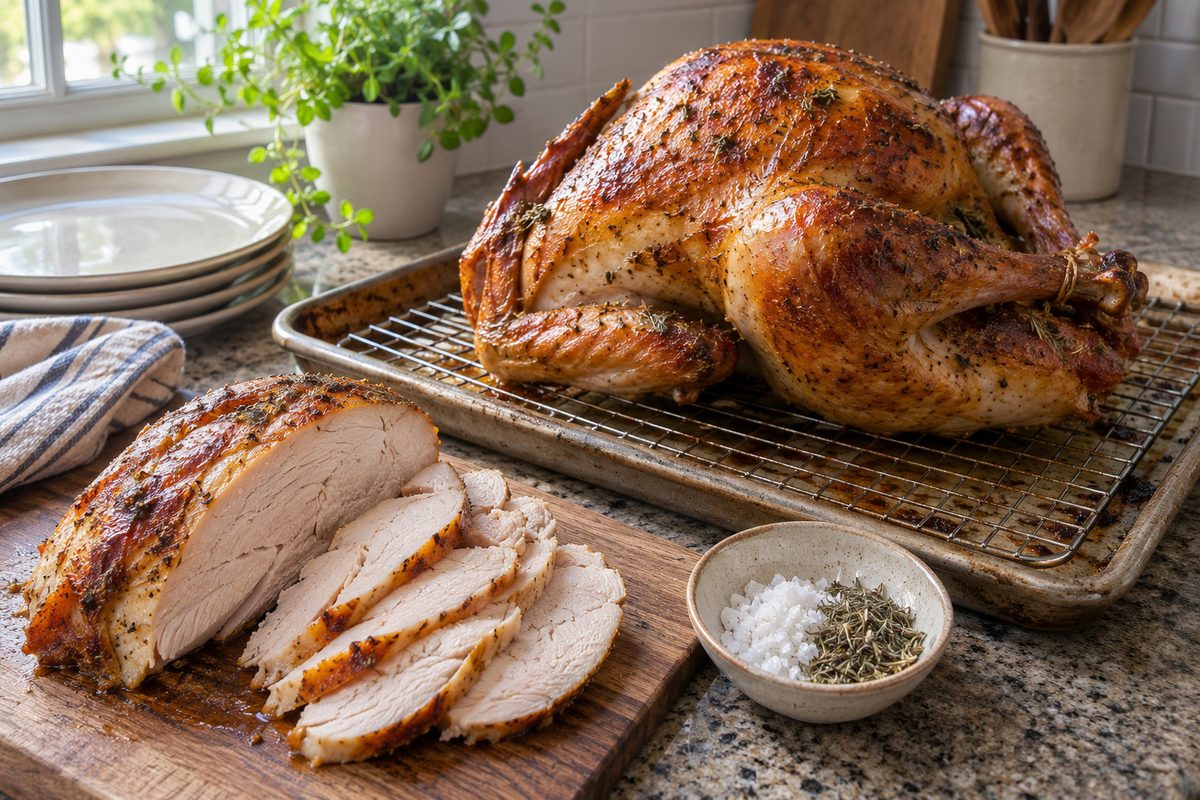
What changes
What makes this Dry-Brined Turkey lighter
A dry brine of salt and herbs
Instead of: A wet brine in a bucket of salt water
No bucket, no sloshing raw-turkey water and no cooler to find space for. The salt draws out juices, dissolves in them and soaks back in, and the skin dries so it browns.
No bucket and no fridge shuffle
1 tbsp olive oil, or nothing
Instead of: A stick of butter rubbed on and basted
Dry-brined skin is already dry and seasoned, so it crisps on its own. A thin coat of oil only helps it brown evenly.
Saves about 30 calories a serving
Skin off on your plate
Instead of: Skin on
For the leanest slice, pull the crisp skin off and keep one bite. The salt has already seasoned the meat.
Saves about 35 calories a serving
Low-sodium broth in the gravy
Instead of: Regular broth plus extra salt
Dry-brined drippings are already salty. Make the gravy with low-sodium broth and taste it before you add any salt.
Saves about 150 mg of sodium per ¼ cup of gravy
Recipe
How to make Dry-Brined Turkey
Prep 20 min, plus 1–3 days in the fridge · Cook 3 hr to 3 hr 45 min, plus 30 min rest · Serves 12 · each serving (4 oz sliced turkey, white and dark, with skin)
Ingredients
- For the turkey
- 1 whole turkey, 12–14 lb, fully thawed, neck and giblets removed (not a kosher, self-basting or "enhanced" turkey, which is already salted)
- 1 tbsp olive oil (optional)
- For the dry brine
- 2½ tbsp Diamond Crystal kosher salt, or 4 tsp Morton kosher salt
- 1 tsp baking powder (optional, for crisper skin)
- 2 tsp black pepper
- 1 tbsp dried thyme or poultry seasoning
- 1 tsp dried sage
- 1 tsp garlic powder
- 1 tsp finely grated orange or lemon zest (optional)
- For the pan
- 1 onion, 2 carrots and 2 celery stalks, roughly chopped
- 1 cup low-sodium chicken or turkey broth
Method
- One to three days before roasting, unwrap the thawed turkey and save the neck and giblets for gravy stock. Pat it dry with paper towels; don't rinse it.
- Mix the salt, baking powder, pepper, thyme, sage, garlic powder and zest in a small bowl.
- Loosen the skin over the breast and thighs with your fingers. Rub about a third of the mix right on the meat under the skin, then sprinkle the rest evenly over the outside and a little inside the cavity, a bit heavier on the thick breast and thighs.
- Set the turkey on a rack in a rimmed sheet pan or roasting pan and put it, uncovered, on the bottom shelf of the fridge (40°F or below), away from ready-to-eat food. Leave it 24 to 72 hours. The skin will look dry and a little see-through; that's what you want.
- On the day, heat the oven to 325°F with a rack in the lower third. Don't rinse off the brine. Brush the skin lightly with the olive oil, if using.
- Scatter the vegetables in a roasting pan, add the broth and set the turkey on a rack over them, breast side up. Tuck the wing tips under.
- Roast for 3 to 3¾ hours for a 12–14 lb turkey, checking from 2½ hours. Tent the breast with foil if it browns too quickly.
- It's done when a food thermometer reads 165°F in the thickest part of the breast and the innermost part of the thigh and wing, not touching bone.
- Rest it, loosely covered, for 30 minutes before carving. The drippings are salty, so make the gravy with low-sodium broth and taste before salting.
- Refrigerate leftovers within 2 hours in shallow containers. Eat them within 3–4 days, or freeze them, and reheat to 165°F.
Quick answers
Dry-Brined Turkey, weight, protein and sugar
Can I eat Dry-Brined Turkey for weight loss?
Yes. A 4 oz serving with the crisp skin is about 210 calories; without the skin, about 175. Either way it's a filling, high-protein base for a holiday plate.
How much protein is in it?
About 31 g of protein in 4 oz.
What about sugar?
No sugar and no carbs in the turkey itself, and the brine has none worth counting.
Tips
Before you cook
- Measure the salt. Diamond Crystal is about half as dense as Morton, and table salt is denser still, so never swap them spoon for spoon.
- Finish thawing first: salt can't get into frozen meat.
- 24 hours works; 48 to 72 hours gives the most even seasoning and the crispiest skin.
- Watching sodium? Use 2 tbsp Diamond Crystal (or 1 tbsp Morton) and don't salt the gravy until you taste it.
Common questions
Dry-Brined Turkey: common questions
How long should you dry brine a turkey?
At least 24 hours and up to 3 days, uncovered in the fridge. Longer gives deeper seasoning and drier, crisper skin.
How much salt do you need to dry brine a turkey?
About 1 tbsp of Diamond Crystal kosher salt per 5 lb of turkey, or about 1½ tsp of Morton kosher salt per 5 lb. For a 12–14 lb bird that's about 2½ tbsp Diamond Crystal or 4 tsp Morton.
Do you rinse a dry-brined turkey before roasting?
No. The salt has already soaked in, and rinsing raw poultry splashes bacteria around your sink. Just pat it dry if the surface looks wet.
Can you dry brine a kosher or self-basting turkey?
No. Kosher, self-basting and "enhanced" turkeys are already salted, so a brine makes them too salty. Season them with pepper and herbs only.
How long do you cook a 15 lb turkey?
At 325°F, the USDA timetable gives 3¾ to 4¼ hours for a 14–18 lb unstuffed turkey. Start checking early and go by the thermometer: 165°F in the breast and thigh.
Does dry brining make turkey too salty?
Not if you measure. The salt seasons the meat rather than sitting on the skin. The drippings are salty, though, so taste the gravy before you add any.
The usual numbers are for 4 oz (white and dark, skin on, butter-basted). This recipe's numbers are estimates from USDA FoodData Central values for the ingredients and serving listed. Your own kitchen will differ a little.