What changes
What makes this Smoked Brisket lighter
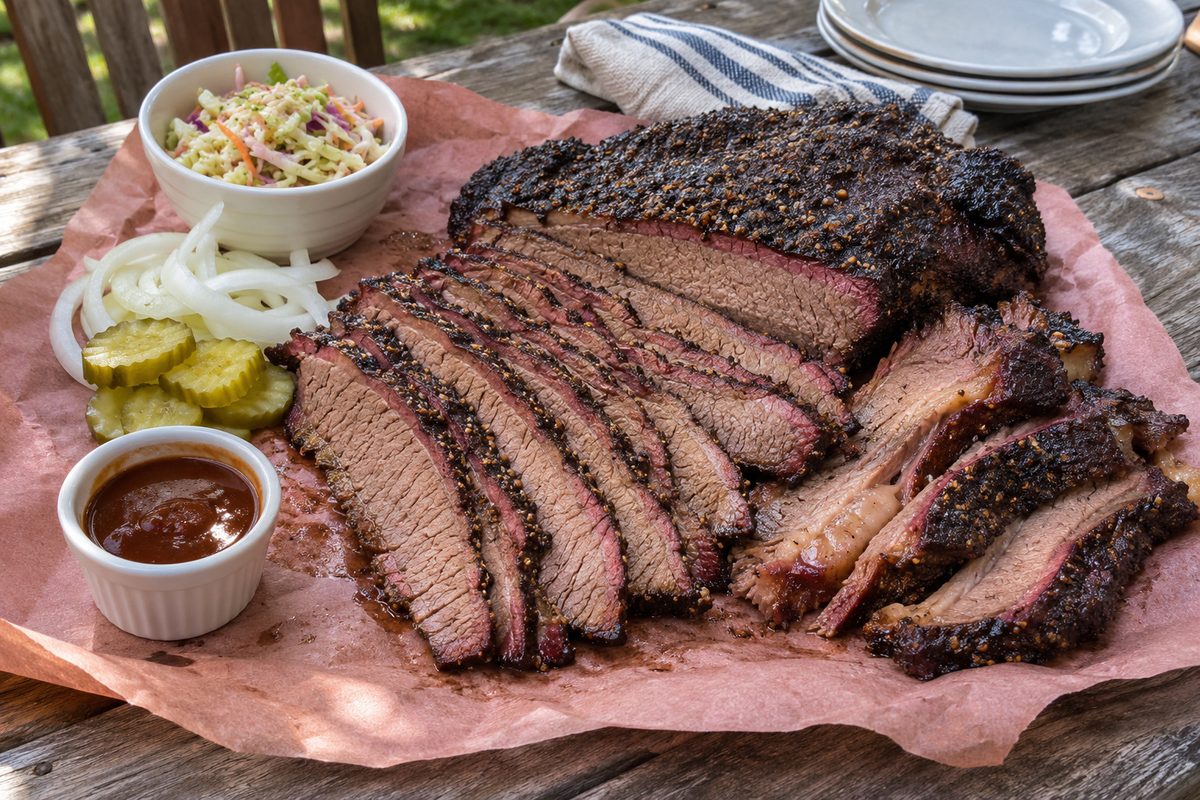
Lean slices from the flat
Instead of: Fatty slices from the point
The point is the thick, marbled top muscle where the juicy 'moist' slices and burnt ends come from. It's great, but it carries a lot more fat. The flat gives you the same bark and smoke with more protein in every bite.
Saves about 150 calories per 5 oz
Fat cap trimmed to ¼ inch before smoking
Instead of: A thick fat cap left on
A ¼-inch layer still bastes the meat and shields it from the heat. Anything thicker doesn't render, so it ends up on the plate or in the trash.
Less fat on every slice, and a better bark
1 tbsp barbecue sauce on the side
Instead of: Slices drowned in ¼ cup of sauce
Good brisket doesn't need much sauce. Most barbecue sauce is about one-third sugar, so a dip on the side keeps the flavor and cuts the sugar.
Saves about 90 calories and 18 g sugar
Vinegar slaw, pinto beans, pickles and onion
Instead of: Mac and cheese, potato salad and white bread
At a BBQ joint the sides can add more calories than the meat. Slaw and beans add crunch and fiber; pickles and raw onion cut the richness the way the classic Texas plate does.
Saves about 300 calories a plate
Recipe
How to make Smoked Brisket
Prep 45 min, plus overnight dry brine (optional) · Cook 12–16 hr, plus 1–4 hr rest · Serves 18 · each serving (5 oz sliced flat, fat cap trimmed, 1 tbsp sauce on the side)
Ingredients
- For the brisket
- 1 whole packer brisket (point and flat together), 12–14 lb, USDA Choice or better
- For the rub
- ¼ cup coarse kosher salt (Diamond Crystal; use 2½ tbsp if Morton)
- ¼ cup coarse-ground black pepper (16 mesh if you can find it)
- 1 tbsp garlic powder (optional)
- For the smoker
- Post oak, hickory or pecan wood (splits, chunks or pellets, to suit your smoker)
- 1 cup apple cider vinegar mixed with 1 cup water in a spray bottle (optional, for spritzing)
- Unwaxed pink butcher paper (or heavy-duty foil) for wrapping
- To serve
- Barbecue sauce, 1 tbsp a serving, on the side
- Dill pickle slices, sliced white onion and vinegar slaw
Method
- Trim the brisket cold, straight from the fridge. Fat side down, cut off the silver skin and hard fat on the meat side, including most of the thick seam of hard fat where the point and flat meet. Keep the two muscles together.
- Flip it. Trim the fat cap to an even ¼ inch, and round off thin edges and corners of the flat that would dry out and burn.
- Mix the salt, pepper and garlic powder and season every side evenly, a little heavier on the thick parts. For the best crust, refrigerate it uncovered on a rack overnight; otherwise season while the smoker heats.
- Bring the smoker to 250°F with clean, thin blue smoke. Put the brisket in with the fat cap facing the main heat source and the thick point toward the hotter side. Put a leave-in probe in the thickest part of the flat.
- Smoke 6–8 hours, until the bark is dark mahogany, doesn't rub off when you touch it, and the inside reads about 165–170°F. After the first 3 hours, spritz any dry-looking edges every hour or so.
- Expect the stall. Somewhere around 150–170°F the temperature can sit still for 2–5 hours while moisture evaporating off the surface cools the meat. It's normal; don't crank the heat.
- Wrap: lay out two overlapping sheets of butcher paper, set the brisket on them fat side up, and wrap it tightly. Put it back in at 250°F, seam side down. Foil works too; it's faster but softens the bark.
- Cook until probe-tender, usually 200–205°F in the flat. The probe should slide in with almost no resistance in several spots, like into soft butter. Total time is roughly 1 to 1¼ hours a pound at 250°F.
- Rest it: open the paper for 10–15 minutes to stop the cooking, rewrap, then hold it in a dry cooler lined with towels for at least 1 hour and up to 4. Keep it at 140°F or above while it waits.
- Slice: separate the point from the flat along the fat seam. Slice the flat across the grain, about as thick as a pencil. The point's grain runs a different way, so turn it 90° and slice it thicker or cube it for burnt ends. Trim off thick fat as you go.
- Serve 5 oz of flat per person with sauce on the side, pickles, onion and slaw. Refrigerate leftovers within 2 hours, eat within 3–4 days or freeze, and reheat to 165°F.
Quick answers
Smoked Brisket, weight, protein and sugar
Can I eat Smoked Brisket for weight loss?
Yes. 5 oz of lean flat with 1 tbsp sauce is about 330 calories with 43 g protein, which keeps you full. At a barbecue the meat isn't the problem; the ½ lb portions, sweet sauce and creamy sides are. Pick the flat, dip instead of pour, and choose slaw and beans.
How much protein is in it?
About 43 g in 5 oz of flat, roughly 13 g of protein for every 100 calories. The same 5 oz from the fatty point has about 33 g protein and about 450 calories.
What about sugar?
Brisket itself has no carbs or sugar. The sugar is in the sauce (about 6 g a tablespoon), sweet rubs, baked beans and cornbread. If you have diabetes, keep the sauce on the side and go easy on the sweet sides.
Tips
Before you cook
- Buy a packer that bends easily when you hold it in the middle. A floppy flat is usually better marbled and more tender.
- Trim cold. Fat cuts cleanly straight from the fridge and gets slippery as it warms.
- Cook to feel, not just the number. 200–205°F is a guide; probe-tender in the thickest part of the flat is the real test.
- Plan for an early finish. A wrapped brisket stays hot in a cooler for hours, but you can't rush one that isn't done.
- Skim the fat off the juices left in the paper and spoon a little of the defatted juice over the slices.
- Slice only what you'll serve. A whole brisket stays juicy; slices dry out fast.
Common questions
Smoked Brisket: common questions
How long does it take to smoke a brisket?
Roughly 1 to 1¼ hours per pound at 250°F, so about 12–16 hours for a 12–14 lb packer, plus at least an hour to rest. Every brisket is different, so start early; a finished brisket can wait in a cooler for hours.
What temperature is brisket done?
Most brisket is probe-tender around 200–205°F in the thickest part of the flat. Go by feel: the probe should slide in like into soft butter. It's safe long before that (USDA's minimum for whole cuts of beef is 145°F), but it isn't tender until the connective tissue melts.
What is the brisket stall?
Somewhere around 150–170°F the internal temperature stops rising, sometimes for hours, because moisture evaporating from the surface cools the meat. Wrapping in butcher paper or foil pushes it through faster.
Should I wrap brisket in butcher paper or foil?
Butcher paper lets some steam escape, so the bark stays firmer. Foil holds all the moisture in, cooks a little faster and gives a softer bark. Both make good brisket.
Do you smoke brisket fat side up or down?
Point the fat cap toward the main heat. In smokers where the heat comes from below (pellet grills, kamados, bullet smokers) that usually means fat side down; in many offset smokers it means fat side up.
How many calories are in brisket?
About 330 in 5 oz of lean flat with 1 tbsp sauce, and about 450 in 5 oz from the fatty point without sauce. A ½ lb BBQ-joint serving of mixed moist and lean slices with 2 tbsp sauce is about 700.
The usual numbers are for a ½ lb BBQ-joint serving (moist and lean slices, fat on, 2 tbsp sauce). This recipe's numbers are estimates from USDA FoodData Central values for the ingredients and serving listed. Your own kitchen will differ a little.