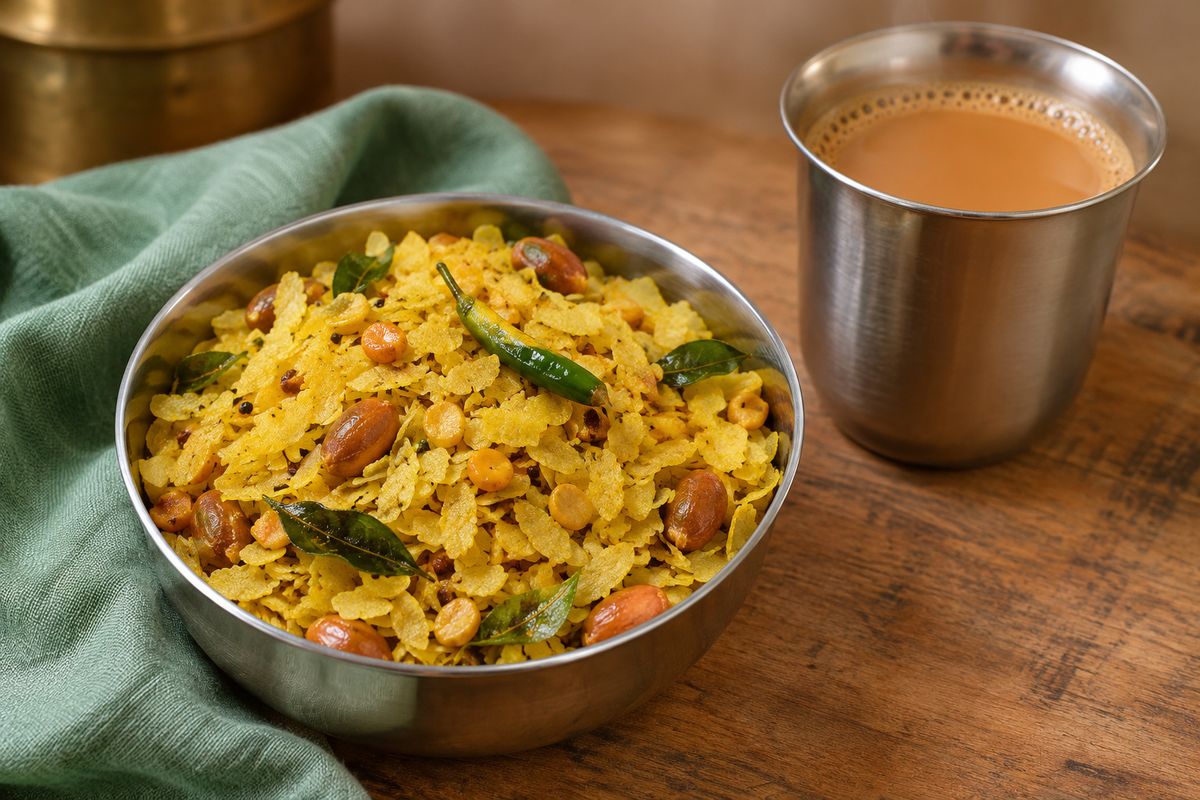
What changes
How this Chivda gets lighter
Dry-roast thin poha
Instead of: Deep-frying thick poha
Thin poha turns crisp in a dry kadhai on low heat. Fried poha puffs nicely but soaks up a lot of oil.
Saves about 20 kcal a handful
Roasted chana dal (dalia)
Instead of: Fried chana dal and cashews
Dalia is already roasted, crunchy and high in protein, so it needs no frying.
More protein, less fat
1/4 cup peanuts and a spoon of coconut
Instead of: 1/2 cup peanuts and 1/4 cup coconut
Peanuts and dry coconut are the richest parts. Keep a little of each for flavour.
Saves about 15 kcal a handful
A small katori with tea
Instead of: Snacking from the jar
Chivda is light to hold but dense in calories. A small katori is one handful; a big bowl is four.
Saves about 360 kcal a sitting
Recipe
How to make healthy Chivda
Prep 5 min · Cook 20 min · Makes 8 · each handful (about 30 g)
Ingredients
- 4 cups thin poha (patal pohe)
- 1 tablespoon oil
- 1/2 teaspoon mustard seeds
- A pinch of hing
- 2 sprigs curry leaves
- 2–3 green chillies, slit
- 1/4 cup peanuts
- 1/4 cup roasted chana dal (dalia)
- 1 tablespoon dry coconut slices
- 1/2 teaspoon turmeric
- Salt to taste
- 1 teaspoon powdered sugar (optional)
Method
- Dry-roast the poha in a wide, heavy kadhai on low heat for 10–12 minutes, stirring gently, until it snaps when broken. Tip into a plate.
- Heat the oil in the same kadhai. Add the mustard seeds; when they splutter, add the hing, curry leaves and chillies and fry until crisp.
- Add the peanuts and fry on low heat for 2–3 minutes, until they crackle. Add the dalia and coconut and stir for a minute.
- Turn off the heat. Stir in the turmeric and salt, then add the poha and toss gently until evenly yellow.
- Sprinkle over the sugar, if using, and toss again.
- Cool completely and store in an airtight jar for up to 2 weeks.
Quick answers
Chivda, weight, protein and sugar
Can I eat Chivda for weight loss?
A handful of fried chivda is about 144 kcal; roasted, about 120. It is light to hold but dense in calories, so measure a small katori and put the jar away.
How much protein is in it?
About 3 g a handful, from the peanuts and dalia. A few more roasted chana add a gram or two.
What about sugar?
Almost no added sugar if you skip the powdered sugar. Poha raises blood sugar fairly quickly; peanuts and dalia slow it. Keep it to a handful, and if you have diabetes, ask your doctor.
Tips
Before you cook
- Roast the poha on low heat and be patient; it should snap, not bend.
- Toss gently once the poha is in, or it breaks into crumbs.
- Store it airtight as soon as it cools, or it turns chewy.
Common questions
Healthy Chivda: common questions
How many calories are in chivda?
Fried chivda has about 480 kcal per 100 g, so a 30 g handful is about 144 kcal. Roasted poha chivda made with a tablespoon of oil is about 120 kcal a handful.
Can I eat chivda in weight loss?
Yes, a handful at a time. Roasted chivda is one of the lighter namkeens, about 120 kcal a handful. It is the second and third handful that add up.
Snack on namkeen through the day? A lipid profile shows where your cholesterol stands. Read about the test
All healthy recipesThe classic numbers come from Swastya AI's dish database for a typical home serving. The lighter numbers are estimates for this recipe, worked out from the oil, ghee, sugar and portion it changes. Your own kitchen will differ a little.