What changes
How this Ker Sangri gets lighter
2 teaspoons of mustard oil for the pan
Instead of: 4 tablespoons
Ker sangri is often cooked like a pickle, in lots of oil. Soaked and boiled, it needs only a little to carry the spices.
Saves about 80 kcal a katori, compared with 4 tablespoons
Amchur and lemon for tang
Instead of: Extra oil and salt
Ker sangri should taste sour and spicy; amchur and lemon bring that without fat.
No calories, more flavour
Boil the soaked ker and sangri first
Instead of: Cooking them through in oil
Boiling softens them fully and takes away some bitterness, so they need far less oil.
Lets you use far less oil
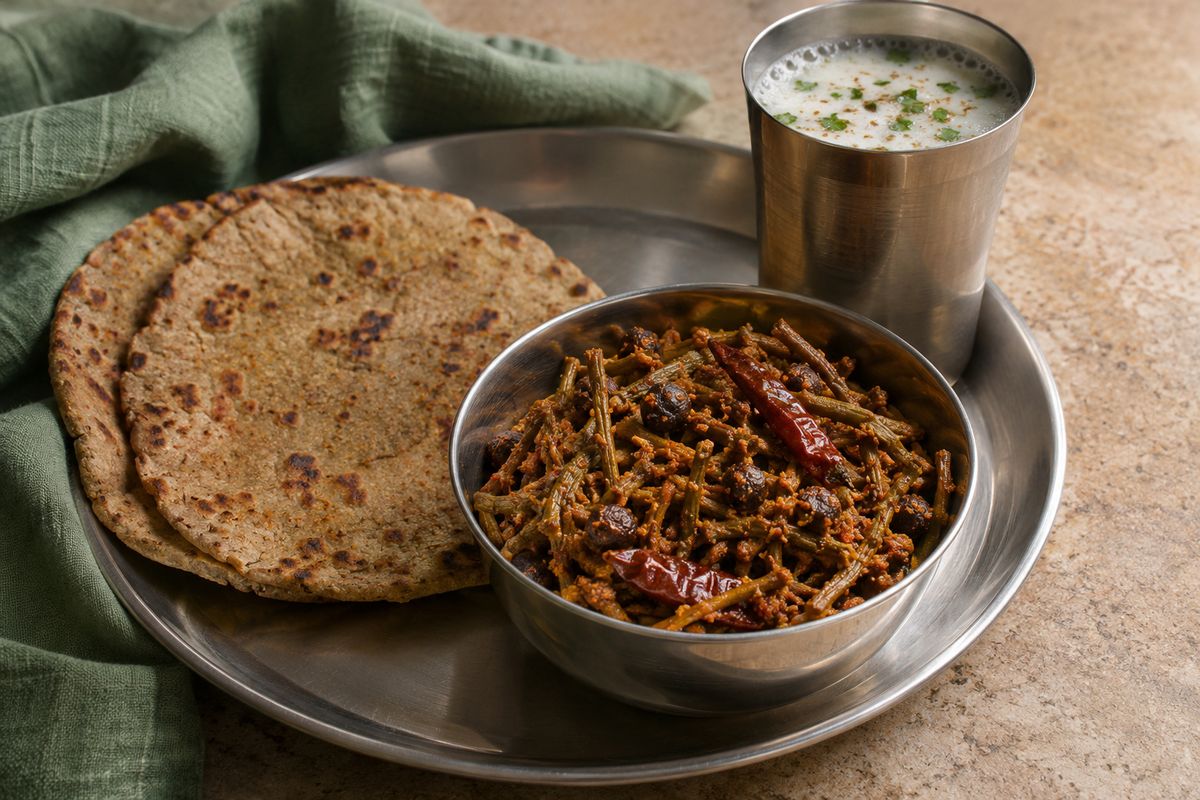
Bajra roti with a glass of chaas
Instead of: Bajra roti dipped in ghee
Ghee on bajra roti is traditional, but each teaspoon is about 45 kcal. Chaas adds protein instead.
Saves about 90 kcal a meal
Recipe
How to make healthy Ker Sangri
Prep 15 min, plus overnight soaking · Cook 30 min · Serves 5 · each katori (100 g)
Ingredients
- For the ker sangri (5 katoris)
- 100 g dried sangri
- 50 g dried ker
- 2 teaspoons mustard oil
- 1/2 teaspoon cumin seeds
- 1/2 teaspoon mustard seeds
- A pinch of hing
- 2 dry red chillies
- 1 small onion, finely chopped (optional)
- 1 teaspoon ginger paste
- 1 teaspoon garlic paste
- 2 green chillies, slit
- 1/2 teaspoon turmeric
- 1 teaspoon red chilli powder
- 1½ teaspoons coriander powder
- 1 teaspoon amchur
- Salt to taste
- 1 tablespoon lemon juice
Method
- Rinse the ker and sangri several times. Soak them in hot water for 6–8 hours or overnight.
- Drain, then boil in fresh water for 10–15 minutes, until soft. Drain well.
- Heat the mustard oil until it just smokes, then lower the heat. Add the cumin, mustard seeds, hing and red chillies.
- Add the onion, if using, and cook until soft. Add the ginger and garlic pastes and green chillies and cook for a minute.
- Add the turmeric, chilli powder and coriander powder with a splash of water so the spices don't burn.
- Add the ker and sangri with salt. Toss, cover and cook on low heat for 8–10 minutes, sprinkling water if it sticks.
- Stir in the amchur and lemon juice and cook uncovered for 2 minutes.
- Serve with bajra roti and a glass of chaas.
Quick answers
Ker Sangri, weight, protein and sugar
Can I eat Ker Sangri for weight loss?
Yes. A katori is about 90 kcal with about 5 g fibre, so it fills you up. Keep the oil to 2 teaspoons for the pan and go easy on ghee for the roti.
How much protein is in it?
About 4.5 g a katori, from the sangri beans. A glass of chaas adds about 3 g and a katori of dal 7–9 g.
What about sugar?
No added sugar, and the fibre in ker sangri makes blood sugar rise slowly. Bajra roti with it is a good pair if you are watching sugar.
Tips
Before you cook
- Soak and boil properly; under-soaked ker stays bitter and hard.
- Use a heavy kadhai and a lid; the steam stops sticking without more oil.
- Make a bigger batch. It keeps 3–4 days in the fridge and tastes better on day two.
Common questions
Healthy Ker Sangri: common questions
How many calories are in ker sangri?
About 90 kcal in a 100 g katori made with little oil. Cooked the traditional way with 4 tablespoons of oil, it can be nearer 170 kcal a katori.
Is ker sangri healthy?
Yes. Ker and sangri are high in fibre, and sangri adds some protein. The only catch is oil; keep it to 2 teaspoons for the pan.
The classic numbers come from Swastya AI's dish database for a typical home serving. The lighter numbers are estimates for this recipe, worked out from the oil, ghee, sugar and portion it changes. Your own kitchen will differ a little.