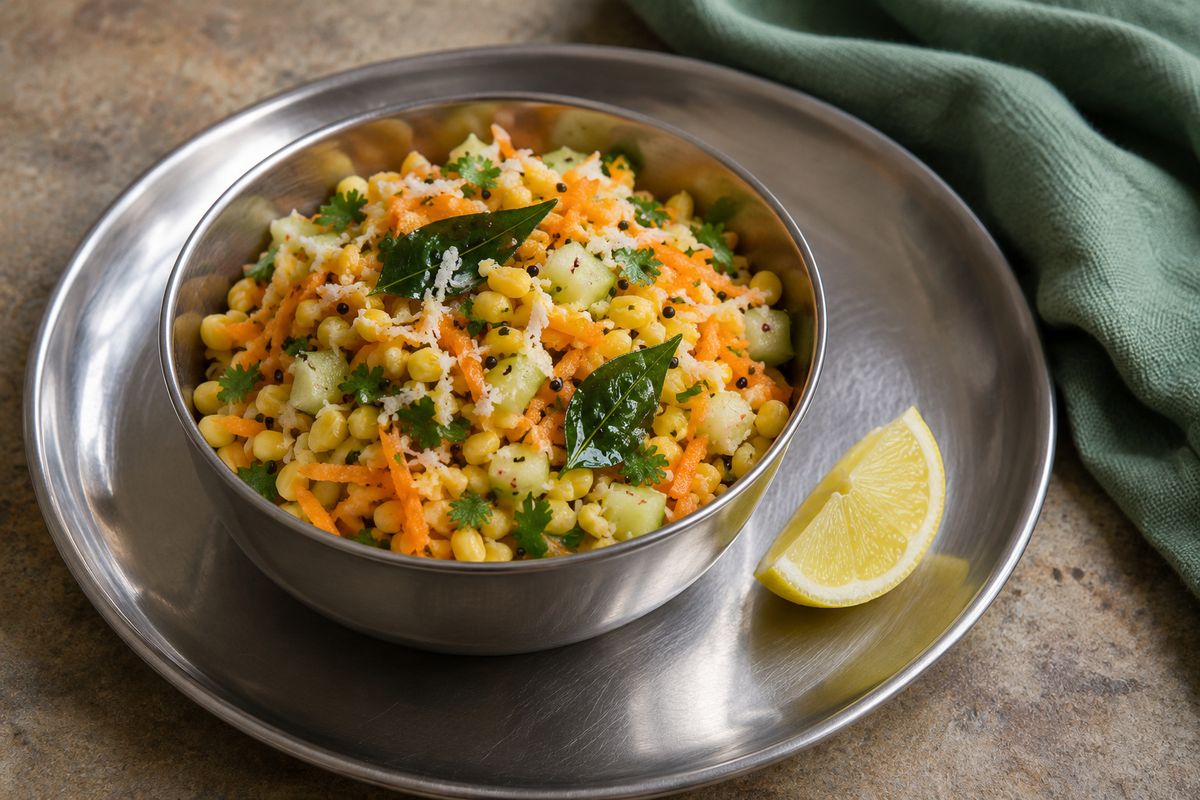
What changes
How this Kosambari gets lighter
1 teaspoon of oil for the tadka
Instead of: 1 tablespoon
The tadka is for the mustard seeds and hing, not to dress the salad. A teaspoon does it.
Saves about 12 kcal a katori
2 tablespoons coconut
Instead of: 1/4 cup
Fresh coconut adds sweetness, but it is mostly fat. Two tablespoons is enough.
Saves about 8 kcal a katori
Extra cucumber and carrot
Instead of: Mostly dal
More crunch and volume for very few calories, while the moong keeps the protein.
A bigger katori for the same calories
A katori at the start of the meal
Instead of: A spoonful on the side
Eating it first takes the edge off your hunger, so you tend to take less rice.
Helps you eat less rice
Recipe
How to make healthy Kosambari
Prep 15 min, plus 2 hours soaking · Cook 2 min · Serves 7 · each katori (100 g)
Ingredients
- For the salad (7 katoris)
- 3/4 cup split yellow moong dal, soaked for 2 hours
- 2 medium cucumbers, finely chopped
- 1 medium carrot, finely grated
- 2 green chillies, finely chopped
- 2 tablespoons freshly grated coconut
- 1/4 cup coriander leaves, finely chopped
- 1 tablespoon lemon juice
- Salt to taste
- For the tadka
- 1 teaspoon oil
- 1 teaspoon mustard seeds
- A pinch of hing
- 6–8 curry leaves
Method
- Drain the soaked moong dal well. It should be soft enough to bite but still crunchy.
- In a large bowl, mix the dal, cucumber, carrot, green chillies, coconut and coriander.
- Heat the oil in a small pan. Add the mustard seeds; when they pop, add the hing and curry leaves and pour over the salad.
- Add the salt and lemon juice just before serving, so the cucumber doesn't go watery.
- Toss well and taste for salt and lemon.
- Serve a katori at the start of lunch, or on its own as a snack.
Quick answers
Kosambari, weight, protein and sugar
Can I eat Kosambari for weight loss?
Yes. A katori is about 90 kcal with about 5 g protein and plenty of crunch. Eat a katori before lunch and you will likely want less rice.
How much protein is in it?
About 5.5 g a katori, from the soaked moong dal. Two katoris make a light snack with about 11 g protein.
What about sugar?
No added sugar. Soaked moong, vegetables and lemon raise blood sugar slowly, and eating it first may soften the rise from the rice that follows.
Tips
Before you cook
- Soak the dal for only about 2 hours; longer and it turns mushy.
- Add salt and lemon at the last minute so the salad stays crisp.
- In summer, add grated raw mango for tang at almost no calories.
Common questions
Healthy Kosambari: common questions
How many calories are in 1 katori of kosambari?
About 90 kcal in a 100 g katori, with about 5.5 g protein. It has very little fat when the tadka uses a teaspoon of oil.
Is kosambari good for weight loss?
Yes. It is low in calories, high in fibre and has some protein. Eat a katori before your meal and keep the coconut and oil small.
The classic numbers come from Swastya AI's dish database for a typical home serving. The lighter numbers are estimates for this recipe, worked out from the oil, ghee, sugar and portion it changes. Your own kitchen will differ a little.