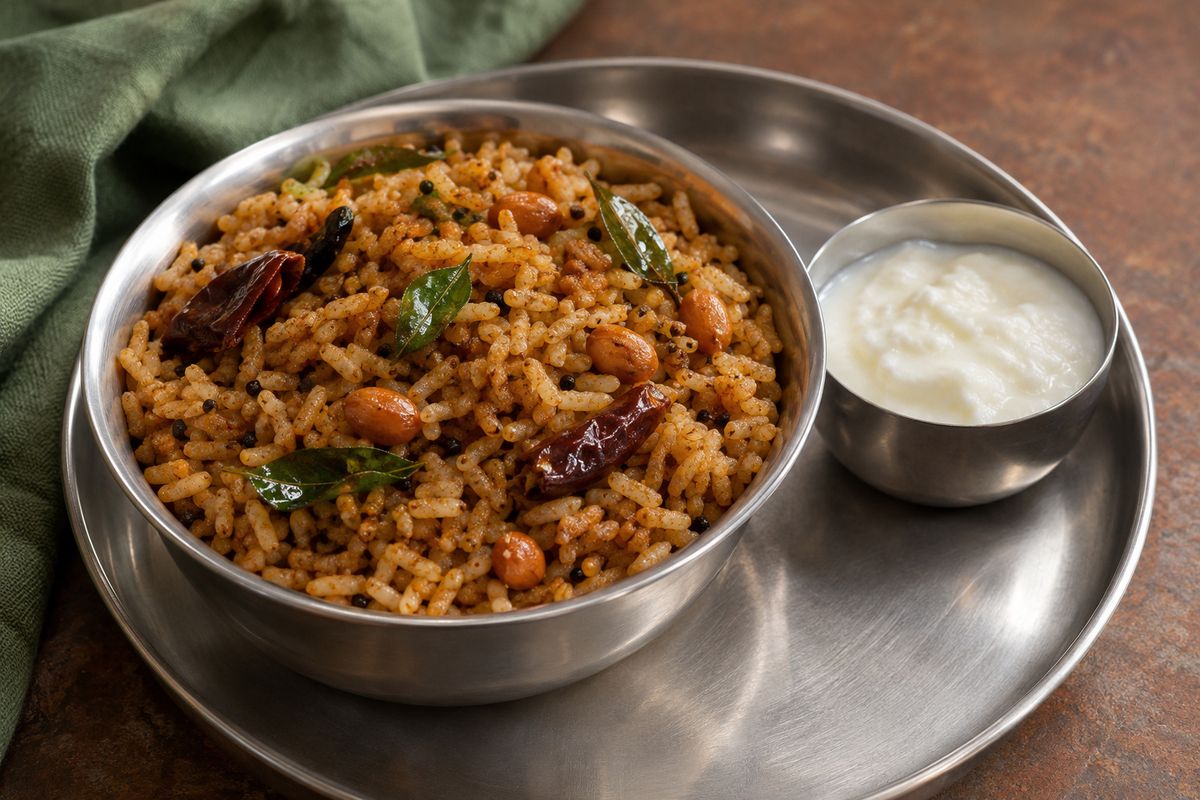
What changes
How this Puliyogare gets lighter
2 teaspoons of sesame oil for the gojju
Instead of: Oily store-bought puliyogare paste
Ready pastes keep long because they are thick with oil. A fresh gojju needs only 2 teaspoons and tastes brighter.
Saves about 30 kcal a katori
Chana dal, urad dal and peanuts in the tadka
Instead of: A plain mustard tadka
The dals and peanuts add crunch and a little protein to every spoon.
More protein
A 130 g katori with curd on the side
Instead of: A heaped katori on its own
Puliyogare is mostly rice. A slightly smaller katori with curd and a vegetable makes a balanced meal.
Saves about 30 kcal a katori
Just a teaspoon of jaggery
Instead of: More jaggery to balance the tamarind
A teaspoon rounds off the sourness. Jaggery has the same calories as sugar, so keep it small.
Less added sugar
Recipe
How to make healthy Puliyogare
Prep 15 min · Cook 30 min · Serves 5 · each katori (about 130 g)
Ingredients
- For the puliyogare powder
- 1 tablespoon coriander seeds
- 1 teaspoon chana dal
- 1 teaspoon urad dal
- 1/4 teaspoon methi seeds
- 1 teaspoon sesame seeds
- 4 dry red chillies
- For the gojju
- 2 teaspoons sesame oil
- 1 teaspoon mustard seeds
- 1 tablespoon chana dal
- 1 tablespoon urad dal
- 2 tablespoons peanuts
- 2 dry red chillies, broken
- A sprig of curry leaves
- A pinch of hing
- 2 tablespoons tamarind paste, in 1/2 cup water
- 1/4 teaspoon turmeric
- 1 teaspoon grated jaggery
- Salt to taste
- For the rice
- 1 cup sona masoori rice, cooked with 2¼ cups water and cooled
- Coriander leaves, to finish
Method
- Make the powder
- Dry-roast the coriander seeds, dals, methi, sesame and red chillies on low heat until fragrant. Cool and grind to a powder.
- Make the gojju
- Heat the sesame oil in a kadhai. Add the mustard seeds; when they splutter, add the chana dal, urad dal and peanuts and fry until golden.
- Add the red chillies, curry leaves and hing for a few seconds.
- Pour in the tamarind water with the turmeric, jaggery and salt. Simmer for 5–6 minutes, until thick and glossy.
- Stir in 2 tablespoons of the puliyogare powder and cook for a minute.
- Mix
- Spread the cooled rice in a wide plate. Add the gojju and mix gently with your fingers so the grains don't break. Add more powder to taste.
- Rest for 30 minutes before serving so the flavours settle.
- Serve a katori with curd and a vegetable poriyal.
Quick answers
Puliyogare, weight, protein and sugar
Can I eat Puliyogare for weight loss?
About 190 kcal a katori. Puliyogare travels well, so it makes a good lunchbox meal; pack one katori with curd and a vegetable side rather than a double helping.
How much protein is in it?
About 4.7 g a katori, from the dals, peanuts and rice. A katori of curd adds about 4 g, and a katori of sundal about 8 g.
What about sugar?
Under 1 g of added sugar a katori, from the jaggery. Rice raises blood sugar quickly; curd and a vegetable side slow it. If you have diabetes, ask your doctor about the rice portion.
Tips
Before you cook
- Cook the rice ahead or cool it well; puliyogare mixes best with firm, separate grains.
- Make extra powder and keep it in a jar for quick puliyogare later.
- It tastes better after resting for 30 minutes, so it suits travel and tiffins.
Common questions
Healthy Puliyogare: common questions
How many calories are in 1 katori of puliyogare?
A 150 g katori of puliyogare has about 210 kcal. Made with 2 teaspoons of sesame oil, a 130 g katori is about 190 kcal.
Can I eat puliyogare in weight loss?
Yes. It is fairly light, about 190 kcal a katori this way. Have one katori with curd and a vegetable, and avoid oily ready-made pastes.
The classic numbers come from Swastya AI's dish database for a typical home serving. The lighter numbers are estimates for this recipe, worked out from the oil, ghee, sugar and portion it changes. Your own kitchen will differ a little.