Skip to content

High cholesterol? Read these four numbers first.

Your lipid profile is four numbers, not one. What each means, what your goal is, and the kitchen swaps that move them.

5 min read · Updated

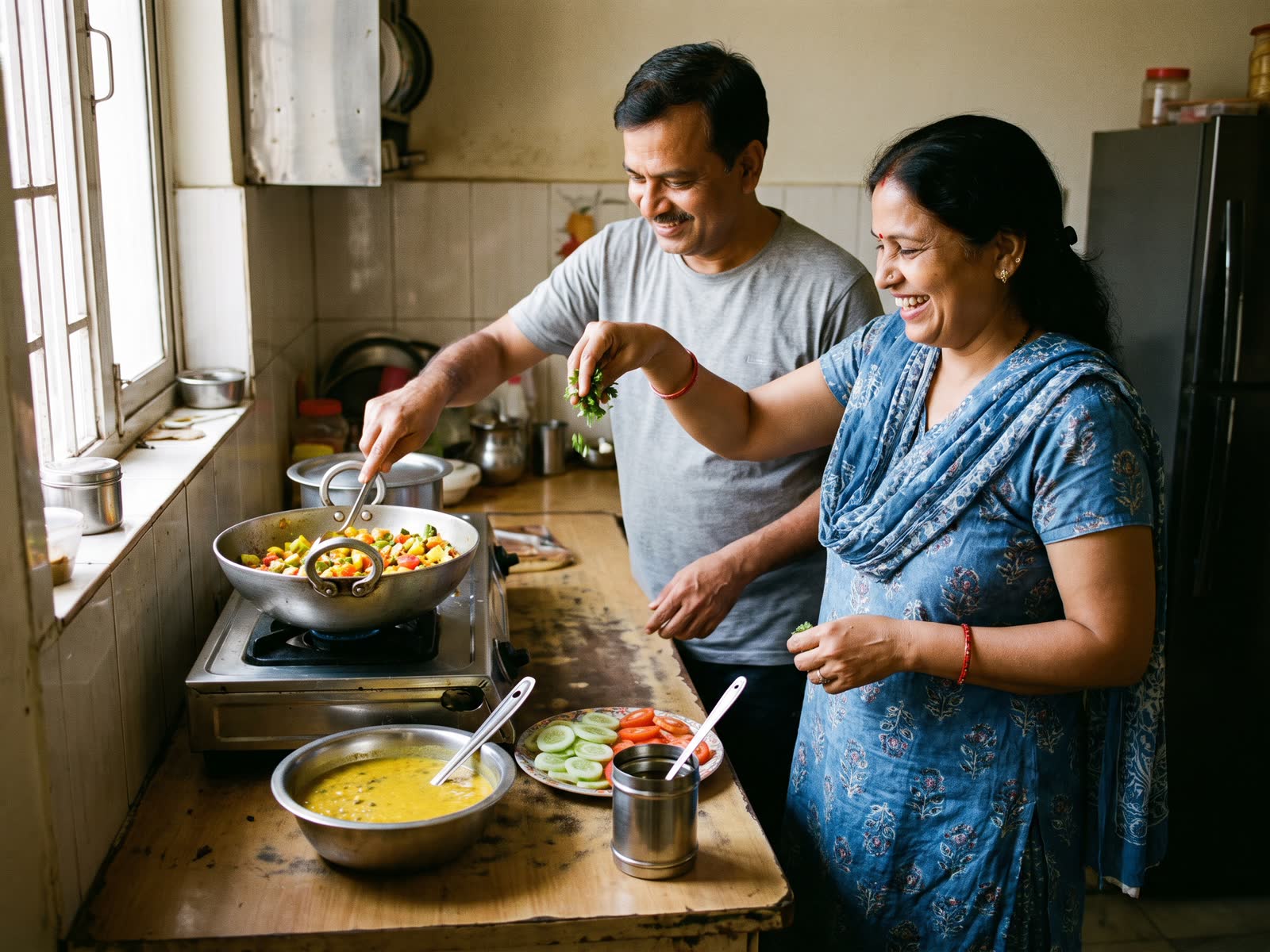
A couple in their fifties laugh while cooking vegetables with very little oil in their kitchen.

The short version

  1. 1

    Nearly 9 in 10 Indian adults tested had at least one abnormal lipid. Low HDL was the most common.1

  2. 2

    Your LDL target depends on your heart risk, not just the band printed on your report.2,3

  3. 3

    In 4-week trials, food changes alone lowered LDL by 12–29%.5,6

Your number

Where does your LDL sit?

LDL is the cholesterol that builds up in artery walls. Slide to your number.

132mg/dL

Borderline high

Time for real changes, and a talk with your doctor about your overall heart risk.

Slide to your own number. Bands from the US ATP III table most labs print. Your own goal depends on your risk.

Your report

The four numbers that matter

LDL, the “bad” one
Goal: below 100 for most people, below 70 at high risk, and below 50–55 at very high risk.2,3
HDL, the “good” one
Below 40 is low, and it’s India’s most common lipid problem. Regular exercise nudges it up.1,4,10
Triglycerides
Below 150 is desirable. Sugar, alcohol and extra weight push them up.4,9,11
Non-HDL
Total cholesterol minus HDL. The goal is 30 above your LDL goal, so below 130 for most people.4

New in 2026

What the new US guideline changed

In March 2026, American heart societies replaced their 2018 cholesterol guideline.

Fixed goals are back
LDL below 100, 70 or 55 depending on risk, with matching non-HDL goals.
South Asians count
South Asian ancestry is now named as a factor that raises your risk.
Lp(a), once
Every adult should test lipoprotein(a) once. It’s set by your genes.

India’s Lipid Association already used similar goals: below 100, 70 and 50.2,3

India

It’s not just about weight

87%
of Indian adults tested in ICMR’s 2026 study had at least one abnormal lipid.1
2 in 3
had low HDL. Abnormal lipids showed up even in people without diabetes, high BP or obesity.1

How to lower it naturally

What food can do in 4 weeks

  • Portfolio diet: plant sterols, soy, fibre, almonds−28.6% LDL
  • Oats every day, Indian style−11.6% LDL
  • Usual diet (the oats trial’s control group)−4.1% LDL
LDL change in two 4-week trials. The oats trial was in Asian Indian adults in New Delhi, eating oats as porridge and upma.5,6

In your kitchen

Five swaps that move the numbers

  • Vanaspati, ghee, butter, coconut oilMustard, groundnut, rice-bran or til oil, mixed or rotated

    Coconut oil raised LDL compared with other vegetable oils, and ICMR advises limiting all four.7,8

  • Sweets, sugary chai, colaLess sugar, a little less each week

    More sugar raised both triglycerides and LDL in trials.9

  • Biscuits and namkeenOats upma, roasted chana, a handful of almonds

    Soluble fibre and nuts lowered cholesterol in Indian trials.6,12

  • AlcoholLess, or none

    Cutting alcohol lowers triglycerides.8

  • Sitting most of the dayA brisk walk, about 150 minutes a week

    Aerobic exercise raised HDL, more so with longer sessions.10

Myths

What you might hear

  • They say

    “Thin people can’t have high cholesterol.”

    Actually

    ICMR found abnormal lipids even in people without obesity, and inherited high cholesterol starts young.1,13

  • They say

    “I’m vegetarian, so I’m safe.”

    Actually

    Most of the fats ICMR asks you to limit are vegetarian: ghee, butter, vanaspati, coconut oil and whole milk.8

  • They say

    “My total cholesterol is normal, so I’m fine.”

    Actually

    India’s biggest lipid problem is low HDL, not high total cholesterol. Read each line.1

  • They say

    “No symptoms, no problem.”

    Actually

    High cholesterol usually has no symptoms. Only a blood test finds it.13

See a doctor soon if

  • Your triglycerides are 500 or more. Very high levels can inflame the pancreas.
  • Your LDL is 190 or more, especially if you’re young or it runs in your family.
  • A parent or sibling had a heart attack young, or your Lp(a) is high.

Call 112 for crushing chest pain that spreads to the arm, neck or jaw, with breathlessness or sweating.

Retest about 12 weeks after you change your habits. LDL responds within 4 weeks, and guidelines recheck at 4 to 12 weeks. Most cholesterol tests don’t need fasting.4,6,14,15


Questions

Questions people ask

How can I lower cholesterol naturally?

Swap ghee, vanaspati and coconut oil for mustard, groundnut or rice-bran oil; add oats and a handful of nuts; cut sugar and alcohol; walk about 150 minutes a week; and lose weight if you are overweight. In 4-week trials, diet alone lowered LDL by 12–29%.

What should my LDL be?

It depends on your heart risk. Below 100 for most people, below 70 at high risk, and below 50–55 at very high risk, such as after a heart attack. Your doctor sets your goal.

When should I first get my cholesterol tested?

The Lipid Association of India advises testing from age 20. The 2026 US guideline also tests children once at 9–11, and every adult should test Lp(a) once in their life.

Do I need to fast for a lipid profile?

Usually not; fasting makes little difference to cholesterol. If your triglycerides come back high, your doctor may ask for a fasting repeat.

How soon will my numbers change?

LDL starts to change within about 4 weeks of a diet change, and guidelines recheck at 4–12 weeks. A retest at 12 weeks shows the full effect of your new habits.

Sources

  1. 1.Deepa M et al. Prevalence of dyslipidemia in India: ICMR-INDIAB-25. Journal of Clinical Lipidology, 2026.
  2. 2.Puri R et al. Key messages from the Lipid Association of India 2024 Consensus Statement IV. JAPI, 2024.
  3. 3.ACC/AHA: 2026 guideline on the management of dyslipidemia (news release, 13 March 2026).
  4. 4.NHLBI: ATP III Guidelines At-A-Glance Quick Desk Reference.
  5. 5.Jenkins DJA et al. A dietary portfolio of cholesterol-lowering foods vs lovastatin. JAMA, 2003.
  6. 6.Gulati S, Misra A, Pandey RM. 3 g of soluble fibre from oats and lipid levels of Asian Indians. Lipids in Health and Disease, 2017.
  7. 7.Neelakantan N et al. The effect of coconut oil consumption on cardiovascular risk factors. Circulation, 2020.
  8. 8.ICMR Guidelines for Management of Type 2 Diabetes, 2018 (lipid and diet advice).
  9. 9.Te Morenga LA et al. Dietary sugars and cardiometabolic risk. American Journal of Clinical Nutrition, 2014.
  10. 10.Kodama S et al. Aerobic exercise training and HDL cholesterol: a meta-analysis. Archives of Internal Medicine, 2007.
  11. 11.Dattilo AM, Kris-Etherton PM. Effects of weight reduction on blood lipids. American Journal of Clinical Nutrition, 1992.
  12. 12.Gulati S, Misra A, Pandey RM. Almond supplementation in Asian Indians with type 2 diabetes: a 24-week study. Metab Syndr Relat Disord, 2017.
  13. 13.NHS: High cholesterol.
  14. 14.NHS: Cholesterol levels.
  15. 15.Grundy SM et al. 2018 AHA/ACC Guideline on the Management of Blood Cholesterol. Circulation, 2019.

Swastya shares health education, not medical advice. Lab ranges vary by lab, age and condition, so read your numbers with your doctor, and see a doctor promptly for any symptom that worries you.

Got a report with a flag? Ask Aira.

Send your lab report on WhatsApp. Aira explains every number in plain words, in your language, and Teresa helps you build one habit at a time, for 12 weeks.