The short version
- 1
No plant oil contains cholesterol, so “cholesterol-free” on a bottle tells you nothing. Look at its saturated fat, and at how much you pour.1
- 2
Keep all visible fat (oil, ghee, butter) to about 27–30 g a day on 2,000 calories: 5–6 teaspoons, with ghee or butter only 1–2 of them.1
- 3
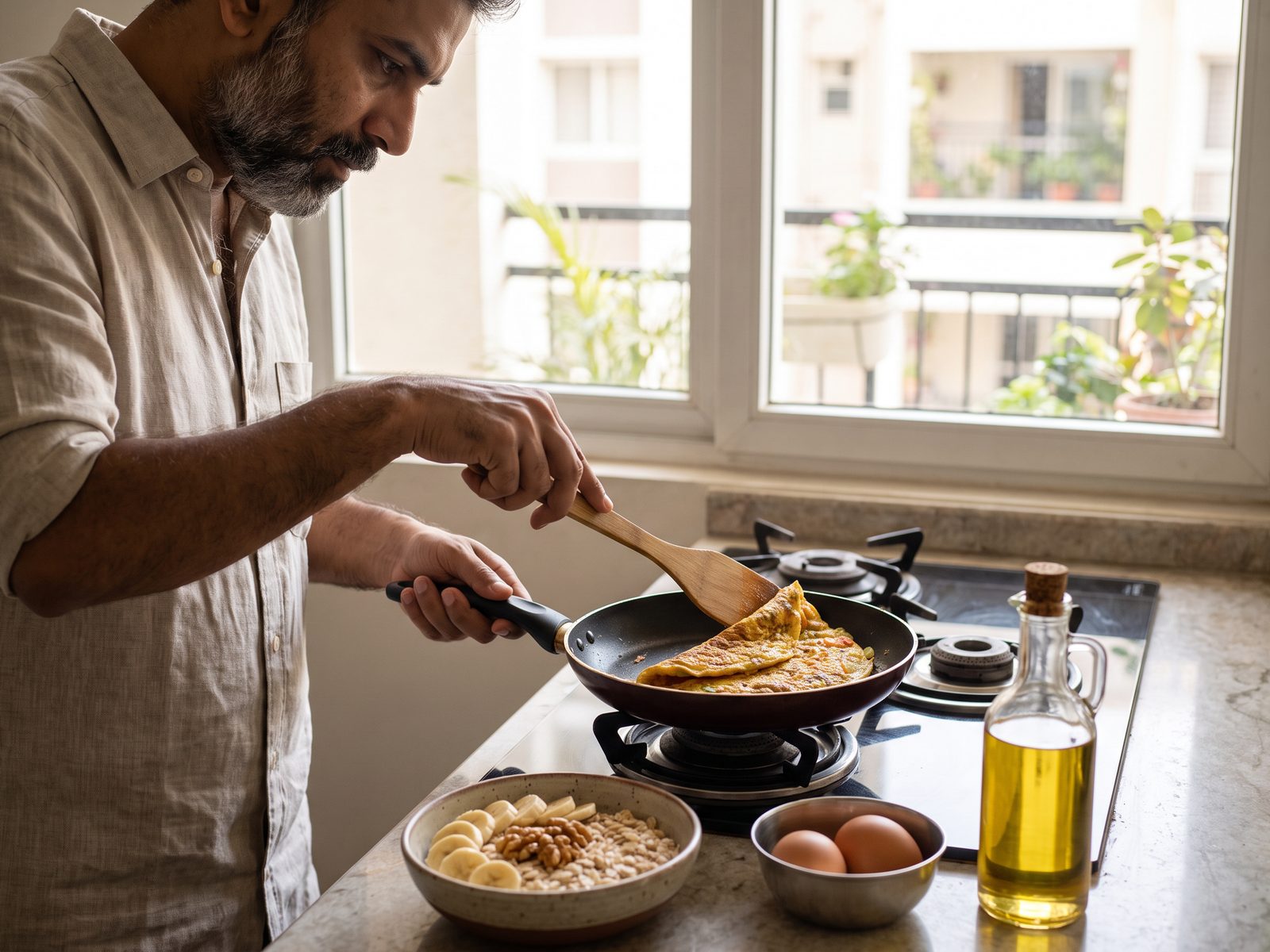
For healthy people, an egg a day is fine. And in a New Delhi trial, 70 g of oats a day lowered LDL by 11.6% in 4 weeks.9,10
The oil shelf
How saturated is your cooking fat?
Guidelines ask you to swap saturated fat for unsaturated. Here is how much of each fat is saturated, from ICMR-NIN’s food tables.
- Coconut oil91%
- Ghee71%
- Vanaspati61%
- Palm oil45%
- Rice bran oil24%
- Groundnut oil19%
- Til (sesame) oil16%
- Soybean oil16%
- Sunflower oil11%
- Mustard oil6%
Ghee is about 71% saturated, so three teaspoons (about 15 g) carry roughly 10 g of saturated fat: ICMR-NIN’s “high” mark for a whole day.1,2
How much
Your day’s oil, in teaspoons
ICMR-NIN counts all visible fat: the tadka, the frying, the ghee on your roti, the butter on your toast.
- Sitting most of the day
- Women 20 g (4 teaspoons). Men 30 g (6 teaspoons).
- Moderately active
- Women 30 g (6 teaspoons). Men 40 g (8 teaspoons).
- Heavy physical work
- Women 40 g (8 teaspoons). Men 50 g (10 teaspoons).
- Ghee or butter
- One or two teaspoons of that total, or none.
ICMR-NIN’s limits, at its 5 g teaspoon. More than 30 g of visible fat on a 2,000-calorie day counts as high.1
One easy way to keep count: pour the day’s oil into a small bottle each morning, and cook from that.
In your kitchen
Swaps for the oil and the pan
- One oil for everythingTwo oils, rotated or mixed
ICMR and RSSDI both advise it: say mustard or groundnut with sunflower, soybean or rice bran.3,4
- Vanaspati and bakery shorteningA measured vegetable oil
ICMR-NIN says avoid vanaspati. Check biscuit, bakery and namkeen labels for trans fat too.1,14
- Frying again in yesterday’s oilUse it once, then in a curry within a day or two
ICMR-NIN: oil used once for frying can go into a curry, but never back into the kadhai to fry.1
- Deep-fryingSautéing, steaming, grilling or baking
The cooking methods ICMR-NIN suggests in place of frying.1
- Ghee on every rotiA plain phulka, and ghee kept to a teaspoon or two a day
ICMR-NIN’s limit for ghee or butter.1
The label
What the bottle is really telling you
- “Cholesterol-free”
- Cholesterol is found only in animal foods, so every plant oil is free of it. FSSAI’s rule for the claim also caps saturated fat, and a food that’s naturally free of something must say “naturally”.1,6
- “Zero trans fat”
- For oils and fats, FSSAI allows the claim under 1 g per 100 g. Since January 2022, industrial trans fat is capped at 2% of the fat in oils, fats and the foods made with them.5,6
- “Kachi ghani” or cold-pressed
- ICMR-NIN notes that cold-pressed and virgin oils contain some undesirable compounds too. Every oil is 9 calories a gram.1
- “Refined”
- Refining doesn’t change an oil’s fatty-acid mix. It does strip some minor compounds, like the oryzanol in rice bran oil, that ICMR-NIN says help lower cholesterol.1
- The back of the pack
- Packaged foods must list saturated and trans fat. Compare those, not the claims on the front.1
Eggs
An egg a day?
- 1 a day
- is fine for healthy people, says the American Heart Association, or two for older adults with healthy cholesterol.10
- 146,011
- people in 21 countries, India included: eating 7 or more eggs a week wasn’t linked to blood lipids or heart events.11
One large egg has about 200 mg of cholesterol, and egg whites aren’t high in it. If you have high LDL, diabetes or heart disease, follow your doctor: ICMR’s diabetes guideline limits yolks when lipids are abnormal.3,10
Oats
How much oats it takes
Oats lower LDL through beta-glucan, a soluble fibre.
- 3 g of beta-glucan a day
- Across 28 trials, this lowered LDL by about 10 mg/dL on average, and by more when it started higher.8
- 70 g of oats a day
- 35 g twice a day, as porridge and upma. In a New Delhi trial, LDL fell 11.6% in 4 weeks, against 4.1% without oats.9
- Instead of, not as well as
- In the trial the oats replaced other carbs. Pick plain rolled oats over sweetened instant mixes.9
The Delhi trial used a branded oat product. For the four numbers on your lipid report, read our cholesterol guide.
Beyond oil
An Indian Mediterranean
In a Spanish trial of 7,447 people at high risk, a Mediterranean diet with extra olive oil or nuts cut heart attacks, strokes and heart deaths by about 30%.
- Plenty of
- Dal, vegetables, whole grains and fruit.
- A handful a day
- Nuts or seeds: almonds, walnuts, peanuts, flaxseed.
- Twice a week, if you eat it
- Fish. RSSDI suggests 100–200 g a week.4
- For cooking
- Mustard, groundnut or til oil in place of ghee.
- Less often
- Fried snacks and sweets.
Our translation of the pattern into Indian food. The trial itself was in Spain.16
Myths
What you might hear
They say
“Cholesterol-free oil lowers cholesterol.”
They say
“Desi ghee is heart-healthy because it’s traditional.”
They say
“Coconut oil is good because it raises HDL.”
Actually
It does, but across 16 trials it also raised LDL by about 10 mg/dL against other vegetable oils.15
They say
“Oats alone will fix my cholesterol.”
Actually
Oats lower LDL by about 10 mg/dL on average. That’s one lever among several.8
They say
“I’m thin and vegetarian, so my cholesterol is fine.”
See a doctor soon if
- Your LDL is 190 or more. Inherited high cholesterol can start young, so mention any family history of early heart disease.
- Your triglycerides are 500 or more. Doctors bring these down first, to protect the pancreas.
- You have chest pain or pressure that won’t go away, spreads to your arm, neck, jaw or back, or comes with sweating, nausea or breathlessness. Call 112 now.
High cholesterol usually has no symptoms. Only a blood test shows it.
Bands from the ATP III table most Indian labs print. Your own LDL target depends on your risk, which the Lipid Association of India asks doctors to judge over your lifetime, because heart disease starts younger in Indians.17,18,19,20