Skip to content

Blood pressure up? Try the DASH diet, Indian style.

DASH isn’t a Western fad. It’s more vegetables, fruit, dal and curd and less salt, and in trials it lowered blood pressure within weeks.

6 min read · Updated

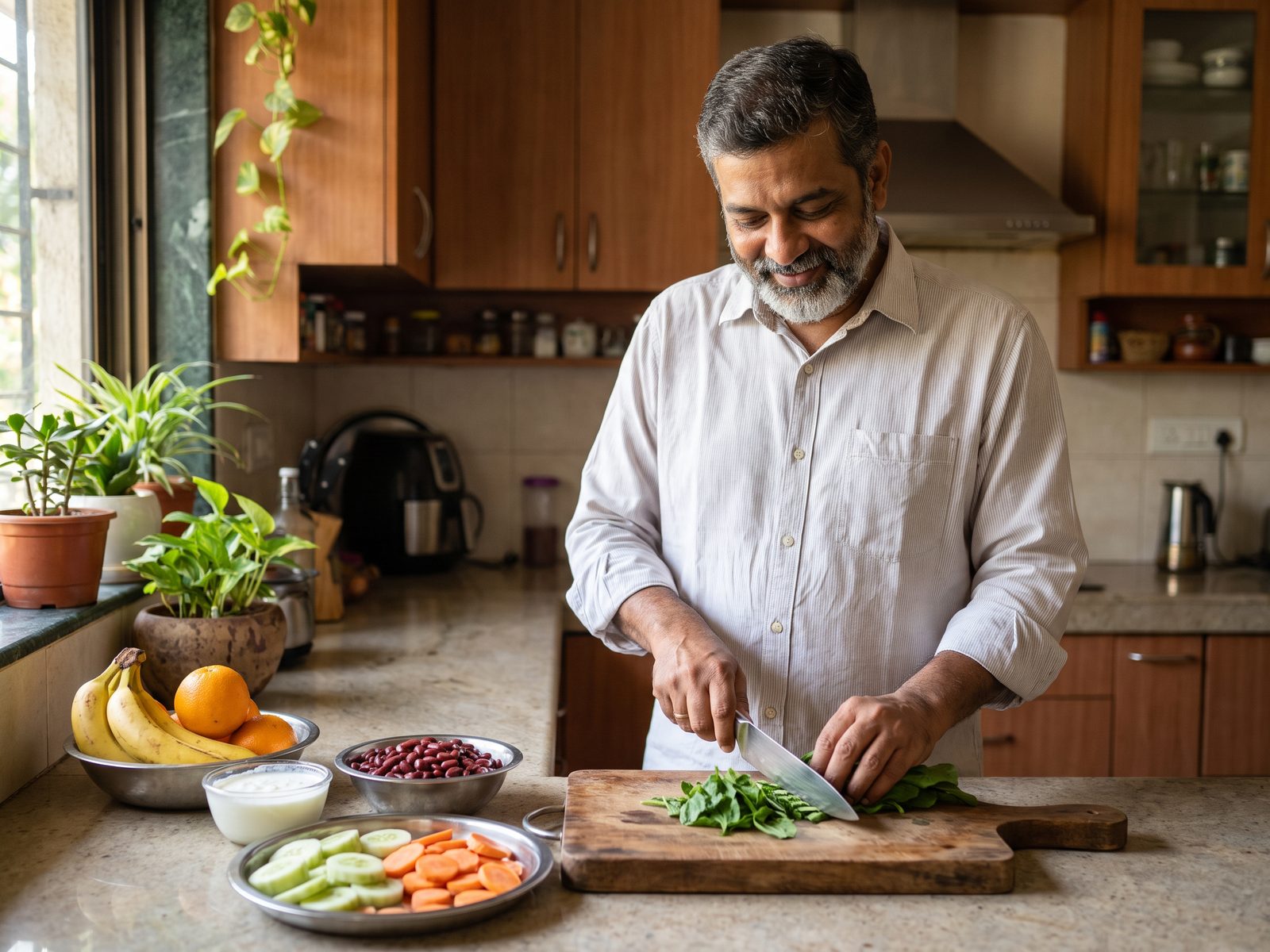
A man in his fifties chops spinach and tomatoes at his kitchen counter, with bananas, oranges, rajma, curd and cucumber and carrot sticks beside him.

The short version

  1. 1

    In its first trial, DASH eating lowered blood pressure by 11.4/5.5 mm Hg in people with high BP, within 8 weeks, without cutting salt.3

  2. 2

    Indians eat about 8 g of salt a day, and most of it goes in at home. Aim for under 5 g: about a teaspoon.7,8,11,14

  3. 3

    Dals, palak, potato, dates and bananas bring potassium, which helps balance the salt.8,16

India

Why this matters here

35.5%
of Indian adults have high blood pressure, in ICMR’s survey across every state.10
8 g
of salt a day is the national average, against WHO’s limit of under 5 g. Studies measuring 24-hour urine found 9.5 g in Delhi and Haryana, and 10.4 g in Andhra Pradesh.7,11,12,13

India’s own guideline calls 140/90 or higher hypertension, and under 130/85 normal.17

The plan

DASH, translated into Indian meals

DASH needs no special foods. Here is NHLBI’s 2,000-calorie plan, with Indian portions next to it.

Grains · 6–8 a day
A serving is half a cup of cooked rice, dalia or millet, or a small phulka. Make most of them whole grains.2,8
Vegetables · 4–5 a day
A katori of salad or half a katori of sabzi each. Lean on palak, methi and other greens.2
Fruit · 4–5 a day
One banana, guava, orange or apple is a serving. That’s much more fruit than most of us eat.2
Low-fat dairy · 2–3 a day
A glass of toned milk, a katori of curd, or chaas made without salt.2
Dal, beans, nuts and seeds
DASH asks for 4–5 servings a week; most Indian homes already eat dal daily. Keep nuts unsalted.2
Fish, chicken, eggs · up to 170 g a day
Grilled, roasted or in a light curry. Vegetarians can let dal, paneer or curd fill this slot.2
Oil · 2–3 tsp a day; sweets · 5 or fewer a week
Less oil than most Indian cooking uses, and count the sugar in chai and mithai.2

The evidence

How much DASH lowered blood pressure

Drop in the top (systolic) number, against the usual diet, in the main trials.

  • DASH, everyone in the trial5.5 mm Hg
  • DASH, people with high BP11.4 mm Hg
  • DASH plus low salt, people with high BP11.5 mm Hg
  • DASH plus low salt, starting at 150 or more20.8 mm Hg
DASH trial (459 adults, 8 weeks), DASH-Sodium trial (412 adults, 30-day periods) and a re-analysis by starting blood pressure. Across 30 trials, the average drop was smaller, 3.2/2.5 mm Hg, and larger in people under 50.3,4,5,6

Salt

Where Indian salt hides

Sodium per 100 g in packaged foods from Delhi and Hyderabad supermarkets.

  • Ready curry and masala pastes3,240 mg
  • Packet soups2,117 mg
  • Achaar1,759 mg
  • Masala mixes1,468 mg
  • Processed cheese1,074 mg
  • Ketchup and table sauces1,020 mg
  • Breakfast mixes847 mg
  • Instant noodles670 mg
  • Namkeen627 mg
  • Bread445 mg
Label averages from 2014; products vary a lot. A tablespoon of achaar at this average carries about 0.66 g of salt.15

Packets aren’t the main problem, though. In North and South India, 83.5–87.7% of salt is added while cooking or at the table. The kitchen namak matters most.14

What to change

Easy salt swaps

  • Salted namkeenUnsalted roasted chana or peanuts

    Namkeen averages about 627 mg of sodium per 100 g.15

  • An extra pinch of saltLemon, amchur, kokum or fresh herbs

    WHO’s advice: cook with little salt and flavour with herbs and spices.7

  • Raita with chaat masalaPlain curd, or chaas with jeera

    Chaat masala is usually made with salt and black salt.

  • Papad and pickle with every mealSalad and a fresh chutney

    ICMR-NIN lists papad and pickles among the saltiest everyday foods.8

Ordering in? Ask for “kam namak”. WHO also suggests switching to a lower-sodium, potassium-containing salt, but people with kidney disease, or on medicines that raise potassium, should ask their doctor first.7,9,18

Potassium

The Indian foods richest in it

Potassium per 100 g, raw, from ICMR-NIN’s food tables.

  • Soybean1,613 mg
  • Toor dal1,395 mg
  • Rajma1,324 mg
  • Moong dal1,268 mg
  • Urad dal1,157 mg
  • Kala chana935 mg
  • Dry dates804 mg
  • Palak625 mg
  • Potato541 mg
  • Banana306–362 mg
A katori of moong dal, from 30 g dry, carries about 380 mg.8,16

Your day

A DASH day, Indian style

Breakfast
Vegetable dalia or oats with toned milk, and a banana or guava.
Mid-morning
A fruit and a few unsalted almonds.
Lunch
Two phulkas or a measured katori of rice, dal, a leafy sabzi, salad, and curd without salt. No papad or pickle.
Evening
Unsalted roasted chana and a glass of chaas.
Dinner
A millet roti or rice with rajma or chole, a vegetable, and fruit afterwards.

An example built from NHLBI’s DASH servings and ICMR-NIN’s plate, not a prescription. If you take blood pressure or diabetes medicines, tell your doctor before a big change.2,8

Myths

What you might hear

  • They say

    “Sendha namak or pink salt is low-sodium.”

    Actually

    ICMR-NIN: whatever the variety, the sodium is almost the same. Use less of any salt.8

  • They say

    “I barely add salt, so mine is fine.”

    Actually

    The national average is 8 g a day, most of it added at home. Fewer than a third of adults know that too much salt harms health.11,12,14

  • They say

    “DASH is a Western diet that doesn’t suit Indian food.”

    Actually

    It needs no special foods. Dal, sabzi, fruit, curd and whole grains fit its food groups directly.1

  • They say

    “Only salt matters for BP.”

    Actually

    DASH lowered BP even with salt held steady. Combined with less salt, it worked best.3,4

  • They say

    “If I feel fine, my BP is fine.”

    Actually

    High blood pressure usually has no symptoms. The only way to know is to measure it.20

Get help if

  • Your BP reads 180/120 or higher: wait five minutes and recheck, then call your doctor if it stays high.
  • That high reading comes with a sudden severe headache, chest or back pain, breathlessness, numbness, weakness, vision changes or trouble speaking. This is an emergency.
  • Chest pain spreads to your arm, neck, jaw or back, or comes with sweating, nausea or breathlessness.
  • Your clinic readings are 140/90 or higher, or home readings 135/85 or higher: book a check.

With kidney disease, or medicines that raise potassium, ask before using potassium salt or making big potassium changes.

Frequent headaches or blurred vision are worth getting checked too.9,17,19,20
Questions

Questions people ask

BP kam karne ke liye kya khana chahiye? Namak kitna khana chahiye?

Keep salt under 5 g a day, about a teaspoon. Eat more vegetables, fruit, dal and low-fat dairy, the DASH way, and cut down on pickles, papad, namkeen and sauces.

What is the DASH diet in simple words?

A way of eating, not a product: plenty of vegetables, fruit and whole grains, with low-fat dairy, dal, nuts and modest oil, and less salt, sugar and saturated fat.

How fast does DASH lower blood pressure?

In the trials, within weeks: the first DASH trial ran 8 weeks, and the DASH-Sodium periods were 30 days each. People who started with higher blood pressure saw bigger drops.

Is sendha namak or pink salt better?

No. Its sodium is almost the same as ordinary salt. Use less salt of any kind.

Which Indian foods are high in potassium?

Dals and beans such as toor, moong, urad and rajma; palak and other greens; potato and arbi; bananas, dates, nuts and coconut water.

Can I follow DASH as a vegetarian?

Yes. DASH counts beans and lentils, and ICMR-NIN’s vegetarian plate uses dal, milk and curd for protein. Let dal, paneer or curd fill the meat servings.

Sources

  1. 1.NHLBI: DASH eating plan.
  2. 2.NHLBI: Following the DASH eating plan (servings and sizes).
  3. 3.Appel LJ et al. A clinical trial of the effects of dietary patterns on blood pressure. NEJM, 1997.
  4. 4.Sacks FM et al. Effects on blood pressure of reduced dietary sodium and the DASH diet. NEJM, 2001.
  5. 5.Juraschek SP et al. Sodium reduction and the DASH diet in relation to baseline blood pressure. JACC, 2017.
  6. 6.Filippou CD et al. DASH diet and blood pressure reduction: a meta-analysis. Adv Nutr, 2020.
  7. 7.World Health Organization: Sodium reduction fact sheet.
  8. 8.ICMR-NIN. Dietary Guidelines for Indians, 2024.
  9. 9.ICMR Guidelines for Management of Type 2 Diabetes, 2018.
  10. 10.Anjana RM et al. Metabolic non-communicable disease health report of India: ICMR-INDIAB-17. Lancet Diabetes & Endocrinology, 2023.
  11. 11.Mathur P et al. National NCD Monitoring Survey (NNMS) in India. PLoS One, 2021.
  12. 12.Mathur P et al. Awareness, behaviour and determinants of dietary salt intake: NNMS, India. Sci Rep, 2023.
  13. 13.Johnson C et al. Mean dietary salt intake in urban and rural India. J Am Heart Assoc, 2017.
  14. 14.Johnson C et al. Sources of dietary salt in North and South India. Nutrients, 2019.
  15. 15.Johnson C et al. Labelling completeness and sodium content of packaged foods in India. Public Health Nutr, 2017.
  16. 16.Longvah T et al. Indian Food Composition Tables 2017. ICMR-NIN.
  17. 17.Satheesh G et al. Indian hypertension guidelines compared with WHO, ISH, American and European guidelines. Indian Heart J, 2024.
  18. 18.Resolve to Save Lives: WHO lower-sodium salt substitutes guideline, overview (2025).
  19. 19.NHLBI: High blood pressure symptoms.
  20. 20.NHS: High blood pressure (hypertension).

Swastya shares health education, not medical advice. Lab ranges vary by lab, age and condition, so read your numbers with your doctor, and see a doctor promptly for any symptom that worries you.

Got a report with a flag? Ask Aira.

Send your lab report on WhatsApp. Aira explains every number in plain words, in your language, and Teresa helps you build one habit at a time, for 12 weeks.